Sudoku uses numbers, but it isn’t arithmetic. It’s a puzzle about placement: every row, every column and every box holds each number exactly once. Every sudoku on PuzzleBee has been checked to have exactly one solution, so each step can be found by logic.
1. Start small
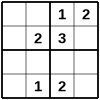
A 4×4 grid uses only the numbers 1 to 4 and four 2×2 boxes. It teaches every idea below in a couple of minutes, which makes it perfect for children and for adults who have never tried.
2. Scan for a number
Pick one number, say 5, and look at every box. For a box that doesn’t have a 5 yet, check which of its rows and columns already contain a 5 elsewhere. Often only one empty square in the box is left where a 5 can go.
3. Find the lonely square
Look at a single empty square and list what its row, column and box already use. If eight of the nine numbers are taken, the ninth is the answer. Rows and columns that are nearly full are the best places to look.
4. Pencil in small notes
On medium and hard grids, write the possible numbers small in the corner of each square. When you place a number, rub it out of the notes in the same row, column and box. Squares with a single note left are ready to fill.
5. Spot pairs
If two squares in the same row can only be 3 or 7, then 3 and 7 must go in those two squares, even if you don’t yet know which is which. You can remove 3 and 7 from every other square in that row. This one idea unlocks most hard puzzles.
A note on mistakes
If you solve on screen, a number that clashes with the answer turns red, which is a gentle way to learn. On paper, use a pencil, and when something goes wrong, go back to the last square you were certain about.